Rebalancer
Solo Lead UX + AI — design and build with Claude Code
Designed and built solo, from concept to App Store
01 — Problem & Context
Tracking pairs that no exchange shows
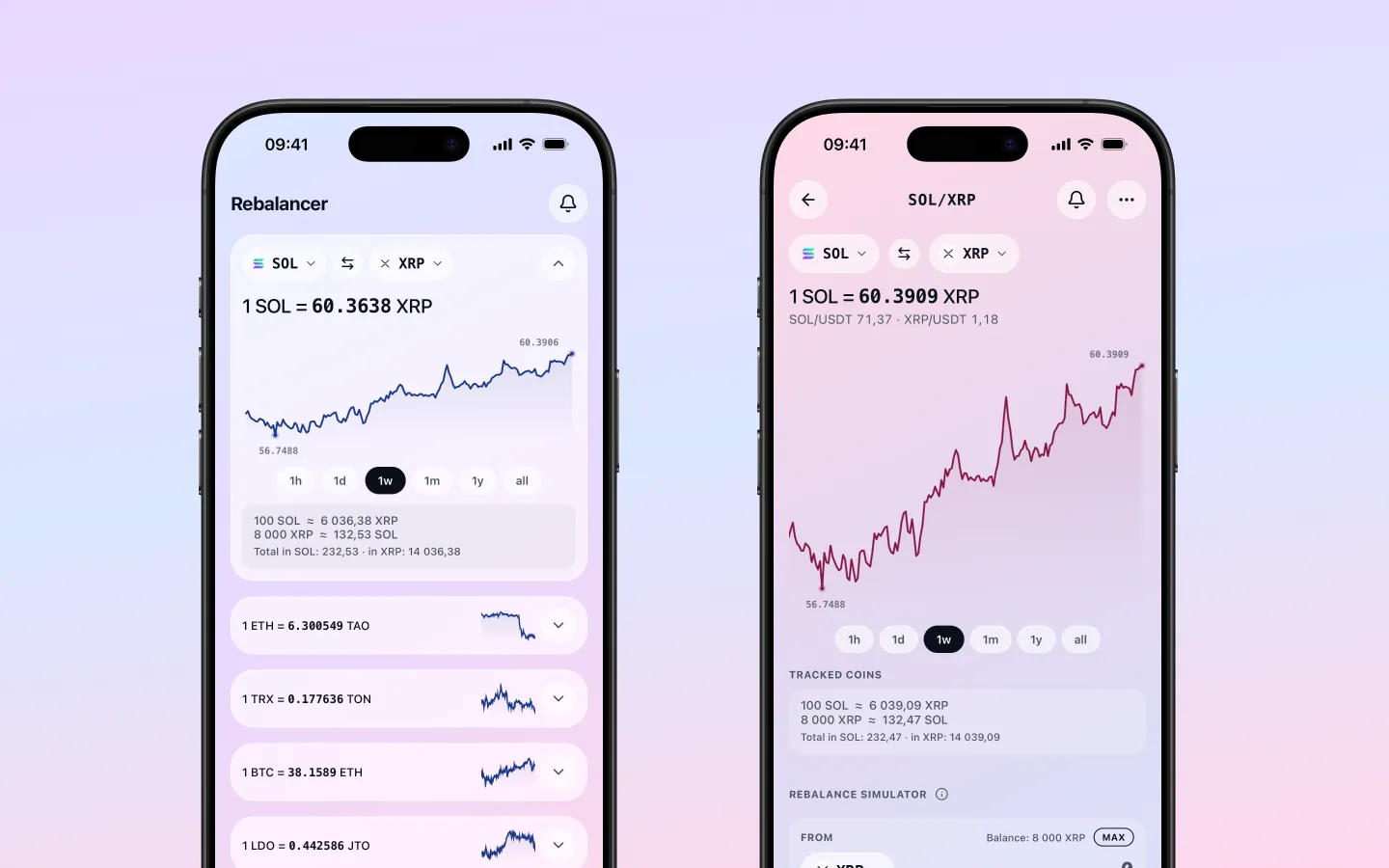
Exchanges and wallets only show altcoins priced against USDT. But rebalancing between two altcoins directly — an ALT/ALT pair — isn't something any of them track.
Before Rebalancer, following a custom pair meant a clumsy workaround: converting through USDT on an exchange, doing the math by hand, and constantly checking back to catch the right moment. No exchange or wallet offered this natively.
For advanced users who rebalance regularly, that meant two real problems: no way to track their own custom pairs, and no way to know when a rebalancing moment had actually arrived.
02 — My Role
One person, whole product
Solo — from idea to App Store.
I owned every layer of Rebalancer myself: the product concept, the UX and interface design, and the full build — iOS app, backend, servers, APIs, and notifications — all developed with Claude Code. No team, no handoff, no separate engineering.
This is what a designer can ship end-to-end when AI collapses the gap between design and code.
03 — The Process
Design-to-code, without the handoff
No Figma, no mockups, no handoff. I built Rebalancer directly in code with Claude Code — design decisions and implementation happening in the same place, at the same time.
The method was disciplined, not improvised. Every change followed the same loop: Diagnose → Plan → Implement. First understand the current state, then agree on a precise plan, then implement it surgically — one small, reviewable change at a time. It kept a solo, AI-built product from turning into chaos.
Diagnose
Understand the current state first
Plan
Agree on a precise plan
Implement
One small, reviewable change at a time
The hardest part wasn't the interface — it was everything behind it. Notification servers, and APIs that had to work across different countries and regions, were the real challenge. As a designer, this meant working through unfamiliar backend territory — and the diagnose-plan-implement loop is what made it manageable.
From idea to App Store: three months.
04 — Key Features
What it actually does
Custom pairs
Create and track altcoin pairs no exchange or wallet shows — ALT/ALT directly, not routed through USDT.
Rebalancing notifications
Get alerted when a pair hits the moment to rebalance — no more constant manual checking.
Coin recalculation
Track how your holdings recalculate as prices move, so you always know where your portfolio actually stands.
05 — Screens
Inside the app
A look at the core flows — custom pairs, the rebalance simulator, notifications, and live coin tracking.
Custom pairs — create and track ALT/ALT pairs
Rebalance simulator — model a rebalance before you act
Notifications — alerts when the moment arrives
Coin tracking — watch holdings recalculate live
06 — Localization
One person, 31 languages
Crypto is global, so Rebalancer had to be. I localized the app into 31 languages — the kind of scope that usually needs a dedicated team.
The workflow was AI-driven but not naive: I generated translations with AI, then ran them through Gemini as a second pass, since its translation quality caught nuances the first pass missed.
The real complexity wasn't the languages themselves — it was the snowball behind them: every new country added its own regional requirements, and the backend had to keep up. Currently awaiting App Store approval for the full 31-language rollout.
AI translation
Generate all 31 languages
Gemini pass
Second-pass quality review
07 — Outcome
Live, and shipped solo
Rebalancer is live on the App Store — a complete product designed, built, and shipped by one person.
The 31-language localization is currently awaiting approval for full rollout. A fresh launch, with the hardest parts — the build, the backend, the global infrastructure — already done.
08 — Reflection
What the build taught me
What I'd do differently
Underestimating the backend was the main misstep. The interface came together fast; the servers, notification infrastructure, and region-specific APIs were where the real time went. Next time I'd scope the invisible parts first.
What I learned
The line between designer and developer is thinner than it used to be. With AI, I shipped something end-to-end that would normally take a team — but only because I worked with discipline, not shortcuts. AI accelerates the parts you understand and is useless for the parts you don't; the diagnose-plan-implement loop is what kept a solo build from becoming chaos. The best results came when I knew exactly what I wanted before asking.